
BUILDING SMARTER, NOT RISKIER
Written by Jessie Rountree, Marin Resilience Manager, Greenbelt Alliance
and Carmela Davis, Housing Specialist, Call Marin Home
Fire-resilient housing can be part of the solution
Critics of more housing in Marin often claim “more housing will create more wildfire risk to me and my community.” As longtime residents of Marin County, we share concern about fire risk. The Bay Area has always had a fire season, and the accelerating impacts of climate change are only making that worse. This month, we explore the impact of new housing on fire risk to understand how we may build a healthier future in Marin.
At Call Marin Home and Greenbelt Alliance, we believe that we have to build with our climate reality and future in mind. New housing doesn’t have to mean more wildfire risk — in fact, done right, it can reduce it. The following practices demonstrate how we can actually build a more resilient Marin through smarter housing.
INFILL DEVELOPMENT, MODERN MATERIALS & CODES REDUCE RISK
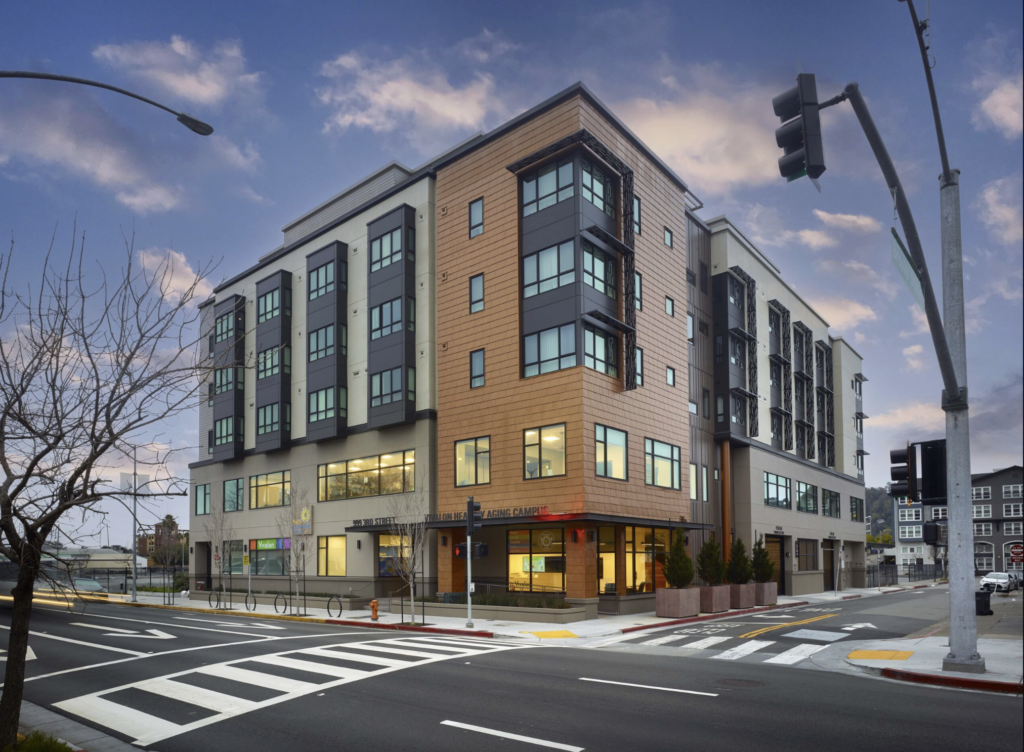
Above: Vivalon Healthy Aging Campus, San Rafael, opened in 2024
Site Climate Smart
Placing homes in urbanized areas and away from high-fire zones is the first line of defense. Developing homes within existing neighborhoods and developed areas (known as Infill development) reduces fire risk. The contrast to infill is sprawl, a familiar practice in much of California that includes low-density residential housing, often on rural, natural, and agricultural lands. Sprawl fragments habitat, severs wildlife corridors, and pushes development closer to the Wildland-Urban Interface (WUI). Homebuilding in the WUI has increased by 25% in Sonoma County, 28% in Napa County, and 41% in Solano County from 1990 to 2020. Statewide, there has been a 40% increase during that same time period. By building homes away from wildlands and within developed footprints, we keep communities safer from wildfire.
NEWER MULTIFAMILY BUILDINGS ARE SAFER
Build fire smart
Material and building standards have improved to meet increasing fire risk, especially for new multi-family housing. Existing housing stock is often older and less fire-resistant than new construction. This is especially true of the wood shingle roofs and siding popular in the County.
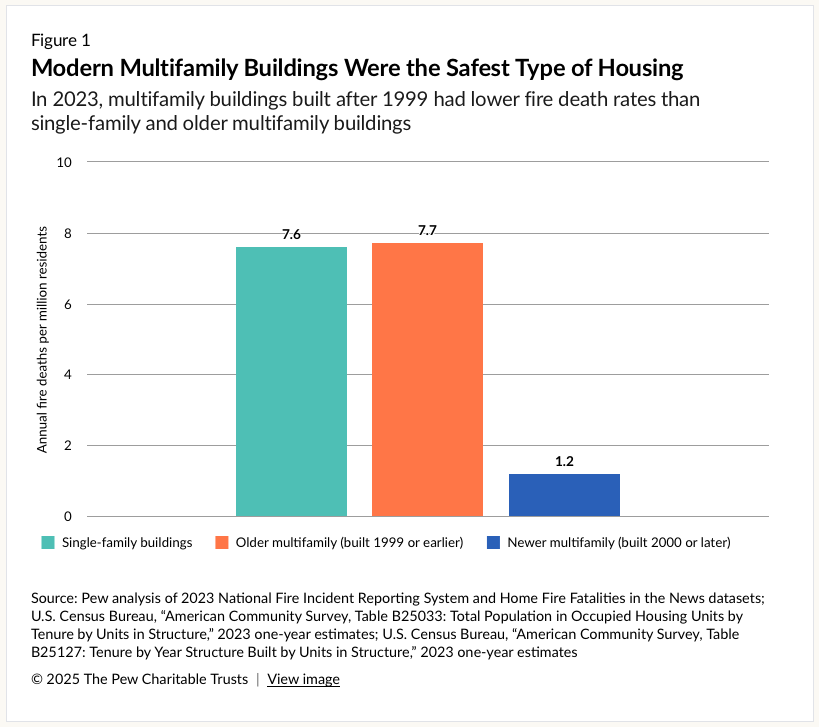
As the vast majority of housing in Marin County consists of single-family homes built during the 1900s, all new infill development will be held to a higher fire standard. New research from The Pew Charitable Trusts now demonstrates that multifamily buildings constructed since 2000 enjoy far better fire safety outcomes than other types of housing, because additional safety measures, such as self-closing doors, fire-safe materials, and sprinklers, have been adopted widely. Additional fire-safe building standards implemented today include:
- Ignition-resistant materials, such as Class A roofing, fiber cement siding, ember-resistant vents
- Mandatory sprinkler systems
- Building setbacks and lot design that create natural defensible space
CAL FIRE and California Building Code standards already require much of this.
Marin County Fire Chief Jason Weber discusses new home development and fire risks in this video, question begins at 1:10.
URBAN WILDLAND INTERFACE & EVACUATION ROUTES
Evacuation
We have heard Fire Chiefs at housing-related public hearings, particularly at the Northgate Mall and 240 Tamal Vista meetings, explicitly outline that new housing will not negatively impact their ability to provide emergency services, nor their response times. In fact, Northgate Mall, being redeveloped for mixed-use housing and incorporating updated building standards, would serve as a likely evacuation location if a fire were to impact Marin County because it would function as a wall to the fire in comparison to green open landscapes and single-family home sprawls.
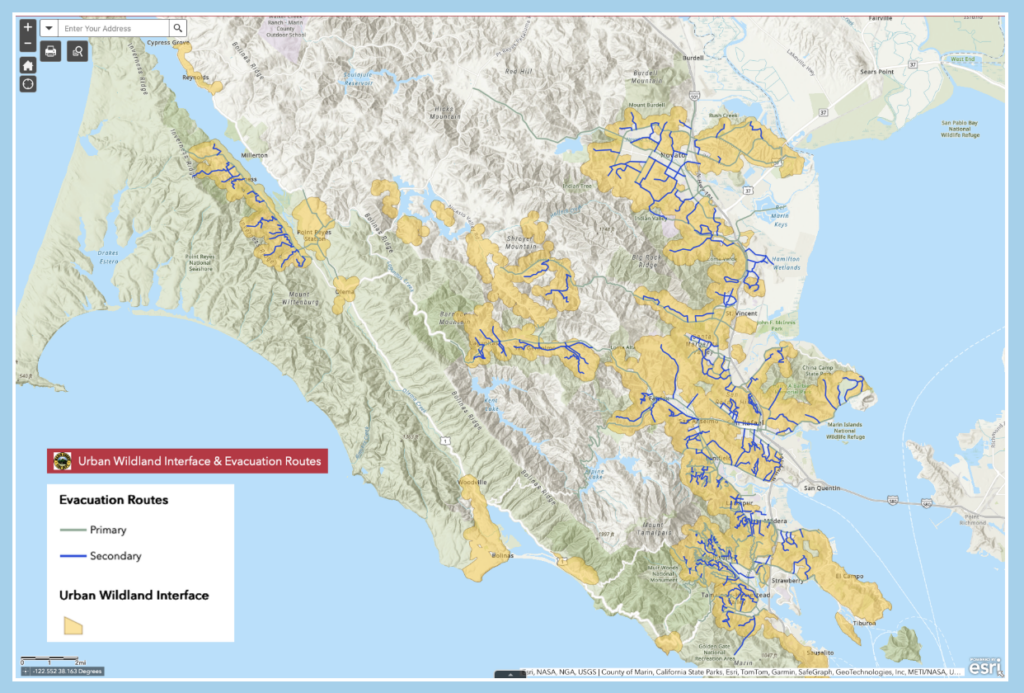
Additionally, our firefighters in Marin County are constantly working on developing the best “worst-case-scenario” plans. Following the 2025 fires in Los Angeles, the evacuation routes and assessments of Marin County preparedness were reevaluated and improved. Adding multi-family housing to the 101 corridor puts less strain on evacuation routes than densifying housing via ADUs and SB-9 lot splits in the hills and more remote residential areas. Safety is the number one concern on the minds of our firefighters and emergency planners, and we have been reassured at local meetings that new infill multifamily housing developments sited and built to code will not cause increased risk if people follow evacuation protocols.
For an interactive map of fire/emergency evacuation routes, go here>>
Investing in resiliency
We are fortunate to benefit from the leadership of the Marin Wildfire Prevention Authority, Fire Safe Marin, and local Fire Departments. They are demonstrating how we reduce fire risk through projects funded by Measure C. And it’s paying off. Marin has among the lowest rate of insurance non-renewals in the Bay Area.
But those interventions—including vegetation management of roadways and open spaces–are expensive and labor-intensive. More residents and more economic development from additional housing provide needed resources to fund needed fire preparedness. Adequate vegetation management ensures roads remain navigable for evacuation and fuel loads reduce the intensity of fires.
Community resiliency
Community connection is our greatest predictor of resiliency after emergencies.
It is mutual aid and grassroots action that repeatedly come to the forefront in communities when facing a common objective. Building new multi-family homes in existing communities puts families closer to jobs, schools, parks, and shopping, giving more Californians access to vibrant, connected communities.
Housing can create less car-dependent spaces, allowing more interactions between neighbors. When you live in an area with denser housing and car dependency is lessened, the likelihood of seeing a neighbor at the park, walking to nearby restaurants and stores, and even in the lobby of the building itself is increased. Walkability also rebuilds the kind of social connections that keep communities healthy and resilient in the face of climate change. Neighbors who know each other are more likely to support one another when fire and other climate impacts occur. Connected communities are more resilient.
Take action!
So, what can we do to build a more climate resilient Marin? We encourage Marin residents and leaders to:
- Prioritize and support climate SMART (sustainable, mixed use, affordable, resilient, and transit oriented) housing construction on infill and transit-adjacent sites rather than WUI parcels.
- Learn what fire risk reduction steps you can implement in your home, including replacing wood shake roofs and vents and managing vegetation at https://www.marinwildfire.org/dspace.
- Sign up for AlertMarin (at https://emergency.marincounty.gov/sign-alertmarin) the primary emergency notification system used by agencies across the County to issue critical information and potentially life-saving instructions.
- Support home hardening and vegetation management programs. Some communities have opposed these programs even though they greatly reduce fire risk. These measures are more effective if implemented on a neighborhood level, so encourage your neighbors to join in.
- Ensure developers engage early with fire agencies and emergency planners during project design.Partner with community members and local climate resilience organizations to expedite and scale up community preparedness.
- Stay updated on new housing projects, research, and status. Visit Call Marin Home and Greenbelt Alliance for info and email options.
Marin County is a wonderful place to call home, blessed with a rich community and extraordinary natural beauty. Concern about Marin’s fire safety in our changing climate is natural, and being engaged in conversations about it is important. Research studies AND the practical experience of professionals show that we can tackle the housing crisis while simultaneously centering fire safety.
By supporting infill housing development and engaging the broader Marin community in working toward a greater level of preparedness, we can build a more climate-resilient Marin.
Want to learn more?
We will explore these complex questions in an upcoming learning series through Climate Resilient Marin.
- Fire risk — won’t building new multi-family buildings increase the risk of fire in our community?
- Evacuation routes — aren’t existing roads already overtaxed?
- Emergency services — how can fire response keep pace with population growth?
- Insurance — isn’t housing in high-risk zones becoming uninsurable?
Sign up to explore additional local climate solutions and build a more Climate Resilient Marin.
We are a broad and strong coalition
Call Marin Home is a collaborative partnership of leading Marin County organizations working to create systemic change that expands access to affordable, workforce, and accessible housing in order to ensure that everyone in Marin has a place to call home. The coalition continues to grow. Interested in joining? Email Jenny. View our current membership here >>.
| Our donors and sponsors make our work possible. Donate now |
| Your advocacy and support help us do more, reach a broader audience, and get results. Every contribution, big or small, makes a meaningful difference and helps us continue and expand our mission. You can donate here. Thank you to our funders, donors, and community partners for supporting our work. |
  . .  . .  . . |