
Digging into the new CEQA reforms: New California laws are intended to reduce obstacles to housing production
Entrenched opposition continues to hamper new housing development in Marin.
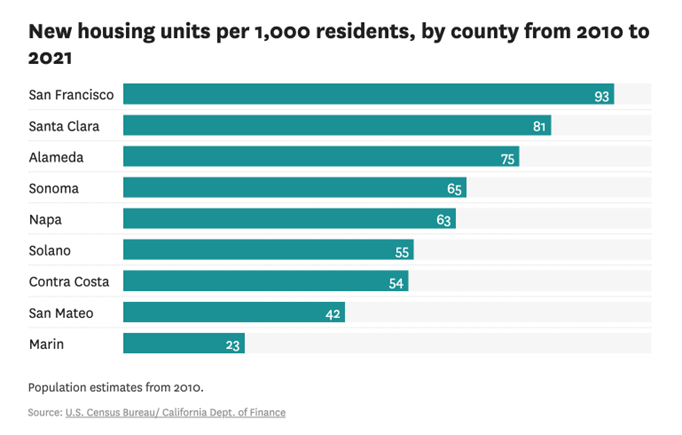
Marin has a serious housing shortage. This housing shortage is not due to a shortage of land. Eighty-five per cent of our land is excluded from development due to open space designations or agricultural easements. But the remaining 15% provides plenty of land for increased housing development, by increasing density in residential neighborhoods or converting underperforming office and retail to housing. Despite the intense demand, very little new housing has been built— Marin has one of the lowest rates of housing production in the state. The graph shows a comparison of housing production in Bay area counties.

Why? Marin has a deep, long history of opposing the construction of additional housing. This has appeared in Marin zoning codes (which mostly permit only single family homes), the continued additions to our preserved open space, and strong opposition to proposed projects. Elected officials who SUPPORT housing, such as former Board Supervisor Susan Adams (regarding a Marinwood project), or even those who DO NOT OPPOSE housing, such as Fairfax council members Lisel Blash and Stephanie Hellman, are voted out of office or threatened with recall.
A frequent tool of housing opponents has been the California Environmental Quality Act (CEQA), signed into law by Governor Ronald Reagan in 1970. The original law applied only to public projects and gave private citizens grounds to file suit against a project. Later court cases broadly expanded the scope of the law to cover private projects. CEQA guidelines have grown from a 10-page checklist to over 500 pages. Projects subject to CEQA must prepare lengthy Environmental Impact Reports (EIRs) that are reviewed through a public process. This process typically requires at least 6 months, and frequently extends to 1-2 years. EIR findings and mitigations are frequently under threat of litigation. Housing projects, especially infill projects (those located in already developed areas) near transit and in wealthy areas, have been the most frequent target of CEQA lawsuits.
The book Abundance by Ezra Klein and Derek Thompson >> reignited debates on CEQA and its impact on housing production in California. It also motivated one of the most unusual legislative maneuvers in recent history. Governor Newsom linked approval of the state budget to the legislature’s passage of AB 130 and SB 131, effectively fast-tracking both measures. By bypassing the standard committee process, the bills avoided extended debate and sidestepped the opposition that had derailed previous efforts to reform CEQA.
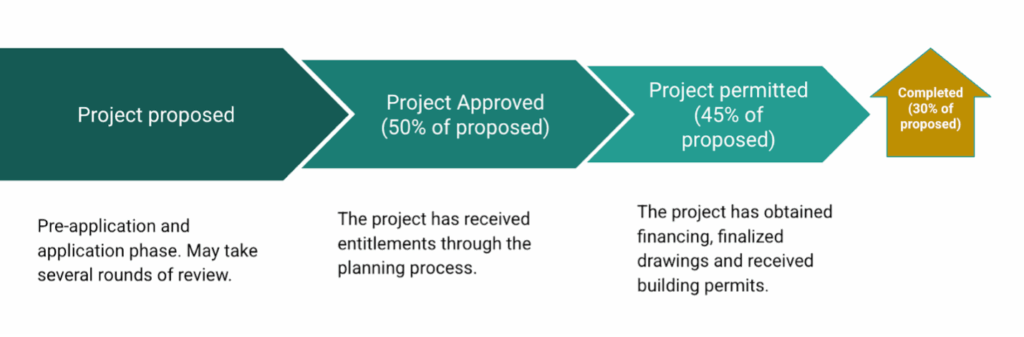
ONLY 30% OF PROPOSED PROJECTS EVER GET BUILT.
AB 130 and SB 131 became effective immediately on June 30, 2025, making them potentially applicable to any projects currently in the CEQA review process. For an elected official to oppose new housing now is merely performative politicking because of the new state mandates. California YIMBY has called this “one of the biggest wins for housing in a generation.” Let’s take a look.
AB 130 – “Modification to California Environmental Quality Act (CEQA)” or “Housing • Infill Housing CEQA Exemption / Streamlining Law”
While its CEQA provisions have received the most attention, AB 130 does much more than reform CEQA. It introduces a number of streamlining provisions that have the potential to speed the approval process for housing projects.
Before AB 130’s passage, if an infill housing project met certain tests, it could be exempted from CEQA requirements pursuant to guidelines contained in the CEQA law. (This potential exemption is called a “Class 32” categorical exemption.) The law firm Holland and Knight has prepared an excellent summary of the new law.

Here are some key differences between the existing exemption rules for infill housing:
- The existing Class 32 exemption exists in CEQA guidelines, which are discretionary and can take 4-6 months to declare. Under AB 130, the exemption is statutory rather than discretionary, which provides stronger legal protection.
- AB 130 has expanded the potential site size for an exempt project from 5 acres to 20 acres, although Builder’s Remedy projects remain limited to 5 acres to be exempt.
- Sites must be developed with “urban uses” or substantially surrounded by “urban uses” to qualify for the CEQA exemption. AB 130 has expanded the definition of “urban uses.”
- The Class 32 guidelines contain construction wage requirements (e.g., “prevailing wage” or union trades). These requirements are eliminated under AB 130 for projects under 85 feet in height, although the exemption does impose potential liability upon the developer for unpaid wages owed to workers.
In short, many housing developments that will qualify for the AB 130 CEQA exemption would have also qualified for the “Class 32” exemption. However, the process would have been much longer and less certain.
AB 130 also streamlines local jurisdictions’ approval processes. This, and several other state streamlining laws, require a tribal consultation process for housing projects. Previously, there was no time constraint for this tribal consultation process. Tribal consultation took 3 years for at least one Marin County project. Now, the tribal consultation process is subject to time limits and jurisdictions must approve or disapprove a qualifying project within 30 days after tribal consultation. This is a significant change.
AB 130 offers a number of additional provisions intended to accelerate housing production in California. These provisions include:
- The National Association of Home Builders estimates that changes to the building codes since 2011 have increased construction costs almost 10%. Further, builders frequently need to redesign projects in process to address changes in building codes. Many Marin projects are struggling to find financing due to high construction costs. The new law imposes strong limitations on the authority of local jurisdictions to amend the standard building codes from October 1, 2025, to June 1, 2031. (There are eight specific exemptions, including amendments for wildfire hardening and to incentivize all electric construction.) This building code amendment freeze will make costs more predictable and reduce cost inflation during t he construction period.
- SB 330, which updated the Housing Accountability and Permit Streamlining Acts have made permanent limitations on local jurisdictions to implement new requirements after a pre-application is submitted and limitations on the number of public hearings on a project which were set to expire in 2030.
- The Permit Streamlining Act (PSA), which requires that ministerial housing projects must be approved within 60 days of a complete application without a public hearing has been extended.
- The Coastal Commission is now subject to the PSA ministerial project approval guidelines. In addition, the permissible reasons for appealing approvals of residential projects to the Coastal Commission have been narrowed.
SB 131 – Public Resources: CEQA Reform / Exemptions and Streamlining for Certain Non-Housing and Infrastructure Projects
Both AB 130 and SB 131 have been advertised as housing streamlining bills. However, SB 131 primarily focuses on general CEQA reforms rather than housing streamlining. Nonetheless, there are some housing-specific issues in this bill.
- SB 131 constrains CEQA review for housing projects that narrowly fail to qualify for a CEQA exemption. CEQA reviews for such projects are now limited to the specific condition that precluded the exemption (e.g., historic resource, wetland, etc.) rather than a complete CEQA review.
- SB 131 exempts some housing element real property rezonings from CEQA review. This streamlines the implementation of housing elements, as typically there is overriding CEQA review of the housing element of a jurisdiction’s General Plan as a whole.
Overall, SB 131 has been much more controversial than AB 130. We want to highlight two provisions that environmental groups are hoping to amend.
- To eliminate or better define the exemption for CEQA advanced manufacturing facilities. This exemption is not well defined, and many question whether it is appropriate to exempt these facilities; oftentimes such facilities may result in greater environmental impacts (e.g., traffic, air quality, toxic emissions) than housing projects.
- To expand the definition of “natural and protected lands” to include habitat for protected species under the federal and state Endangered Species Acts and the state Native Plant Protection Act.
So will these bills deliver more housing?
It’s too early to tell, but they do appear to address several of the gaps we’ve witnessed in the approval process for projects. Reducing legal and administrative requirements will also shorten the approval process and consequently, the costs associated with housing developments. Delays cost money, and when housing projects already struggle with financial feasibility, it is important to ensure a faster approval process. We have seen CEQA exemptions denied, then appealed, then granted and appealed, adding months to the approval process. Ministerial projects have taken over a year to be approved.
On the surface, it appears that these new laws will shorten these timelines.
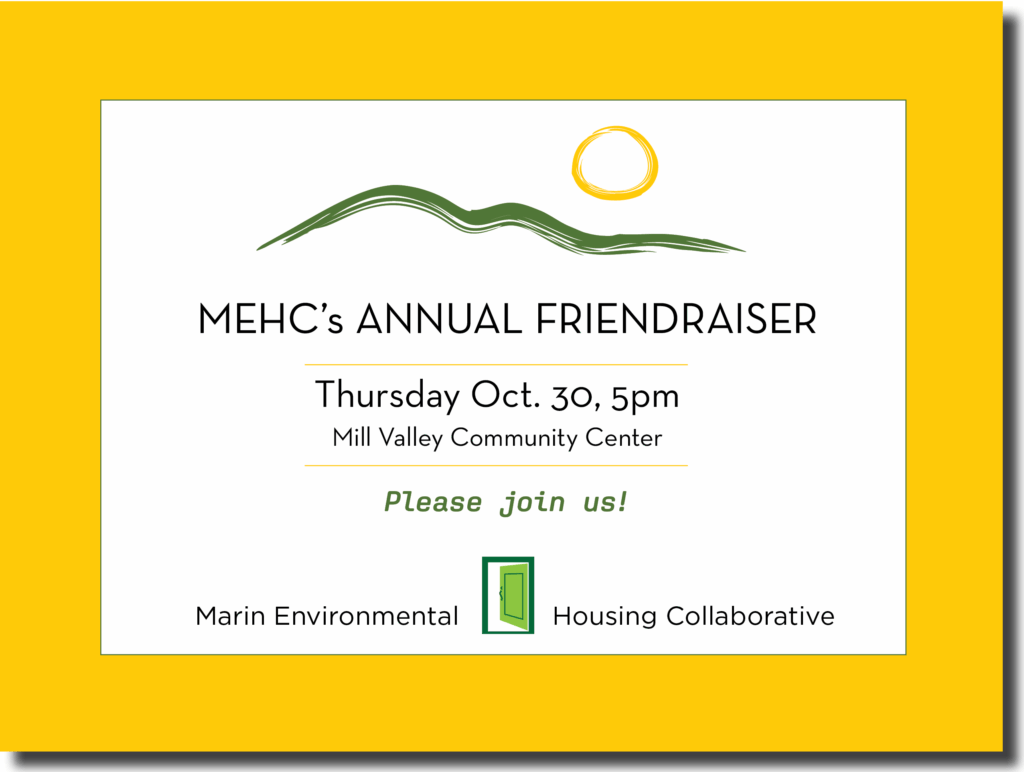
| BE THERE FOR OUR BIG REVEAL! MEHC brings together friends and fellow housing advocates to renew friendships, enjoy delicious local food, raise funds to support our efforts, hear about housing progress in Marin— Supervisor Eric Lucan will share his views— and this year, to unveil a big surprise. Get your tickets now! |
| R E S O U R C E S Explore the broad library of resources on our website including news, policy statements, advocacy, upcoming meetings, fact sheets and backgrounders on affordable housing – and the lack of it – in Marin. If you have any questions or suggestions, contact us here>> |
 GET YOUR TICKETS TO OUR FRIENDRAISER, and don’t miss our Big Reveal! You can be a part of MEHC’s important work by reading & sharing our monthly PERSPECTIVE newsletters, joining our weekly COMING UP IN HOUSING email list (signup here>>), participating in our advocacy campaigns, and also, if you can, by donating >> to help defray our expenses. Thank you. |