
The 3 Ps: An integrated solution
Marin’s housing crisis is solvable. The tools exist. What has been missing is the discipline (and courage) to use them.
People who work on housing affordability organize their thinking around three Ps: Protection, Preservation, and Production. In public debate, these often get treated as competing goals emanating from competing camps. Tenant advocates push protections. Builders push production. Nonprofits push preservation. Each side worries the others are a distraction from what really matters.
That framing gets it wrong. The three Ps are not a menu where we choose one. They are parts of a single system, and each one only works when the other two are moving at the same time.
PROTECTION: Keeping People Housed
Protection means protecting the people who already live here but are at risk of immediate displacement from their homes. That includes supporting policies such as rent stabilization, just-cause eviction ordinances, tenant legal services, emergency rental assistance, and resistance to proposals by investors who seek profits by upgrading or replacing affordable housing with housing that is unaffordable to current tenants. (This is also an issue for the Preservation camp.)
The logic is simple. Displacement is far easier to prevent than to reverse. Once a family, a senior on a fixed income, or a longtime renter is pushed out of housing here, they cannot afford to relocate in Marin and almost never come back. Their kids change schools. Their jobs become long commutes. Seniors on fixed incomes are priced out. The community loses teachers, first responders, caregivers, and neighbors it cannot easily replace.
This demographic shift carries a long-term cost for everyone. The Rooted in Marin report (2025) warns that without action, the county risks fewer economic opportunities, deeper economic and racial disparities, and a shrinking population of working-age residents and young families which will negatively impact future community sustainability.
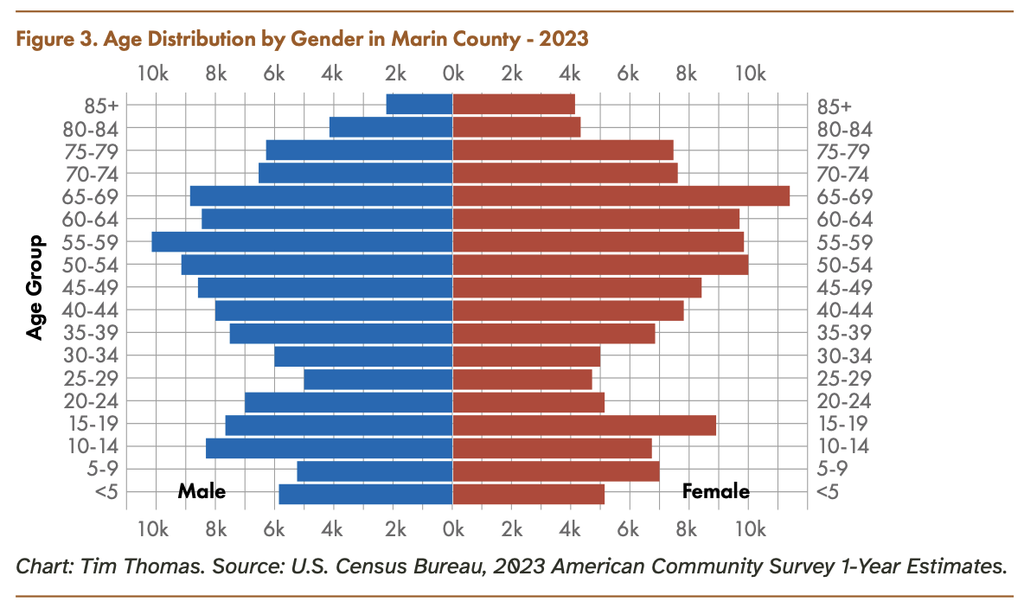
The population “age pyramid” above illustrates population distribution by age and gender. In a healthy demographic structure, the “pyramid” typically has a broad base, indicating a larger population of children and families compared to older adults, supporting a thriving local economy by ensuring an adequate workforce for businesses and community services. However, Marin County’s pyramid displays an inverted structure, with a disproportionately large aging population at the top, creating several challenges. The pyramid’s notably narrow bars in the 25-44 age ranges indicate fewer working-age adults and families, likely due to displacement and the prohibitively high cost of living.
An older population and fewer young families signal continued population declines, affecting the housing market, workforce, and economy. Rooted in Marin, p. 16
PRESERVATION: Holding on to What We Have
Preservation means protecting the affordable housing Marin already has. That stock, the majority of which was built prior to 1970, is more fragile than most people realize.
Much of it is what planners call naturally occurring affordable housing: older apartments with modest rents, no subsidy, and no legal restrictions. These units are affordable only by circumstance — home to long-term residents whose rents were kept lower than market-rate because of caps on rent increases and benevolent owners. When a building sells (frequently to a corporate owner), rents often reset to market, utilities and junk fees get added on, and the affordability disappears overnight — all while the aged building continues to deteriorate.
Preservation policies turn those units into dignified and permanently affordable housing. It can mean helping nonprofits, tenants, or community land trusts buy buildings and record deed restrictions that keep rents affordable for decades. It also means maintaining the subsidized housing we have already built, so it stays safe and livable rather than slowly falling out of service.
Strong anti-displacement ordinances support preservation, too. They give owners an incentive to maintain aging rental properties rather than let them decline or flip them for higher rents. At the same time, they address the threat of displacement that comes with gentrification, so preserved buildings keep serving the residents and local workforce who already live there.
Housing supply is insufficient for Marin’s needs.
PRODUCTION: Building What We Need
Production is where Marin has its biggest gap. We have simply not built enough homes, at enough price points, for the people who live and work here.
Closing that gap starts with zoning that allows multifamily housing in more places, especially near jobs, transit, and services. It requires approval processes that are fast, predictable, and supported by the wider community, so a good project does not die from years of delay and uncertainty. And it requires local funding that makes Marin’s affordable projects competitive for state and federal dollars, which rarely flow to places that seemingly bring nothing to the table.
The housing shortage is also the root of why we need the other two Ps.When too many households chase too few homes, rents climb, buildings flip, and residents lose their bargaining power. That is what makes protections urgent and preservation so costly. Every year that Marin underbuilds, the pressure on our low- and middle-income workforce and existing affordable units grows. Production does not replace protection or preservation, but without it we will always be fighting the symptoms instead of the cause.
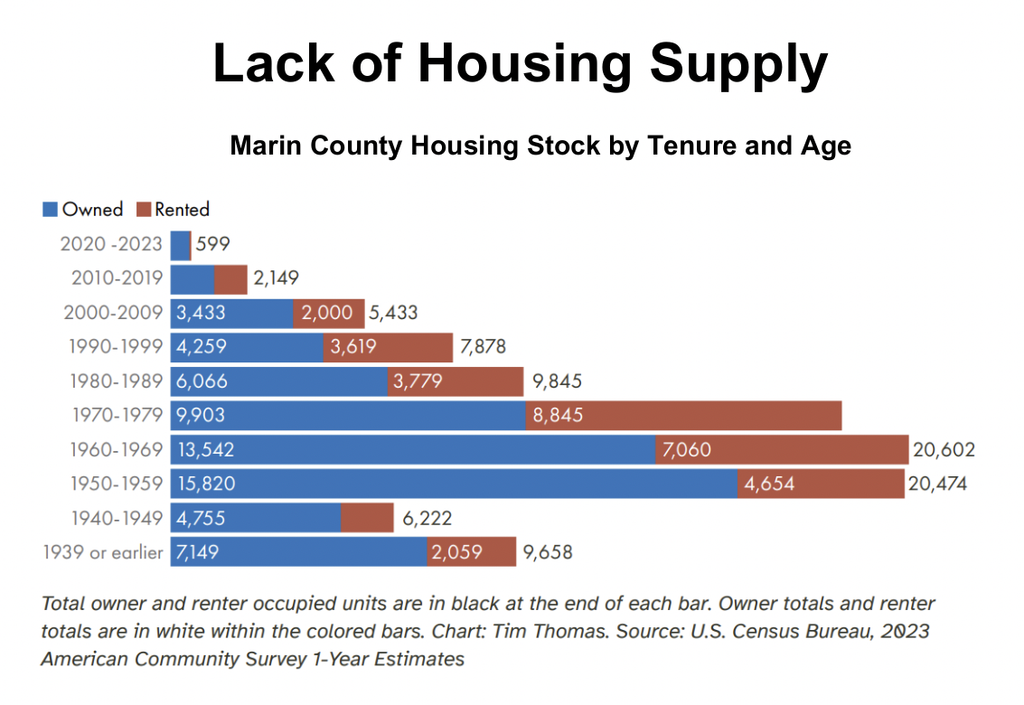
Since 1970, roughly 42% of the homes that were built are now used as rental units. However, since 2020, only 11% of homes are used for rentals.
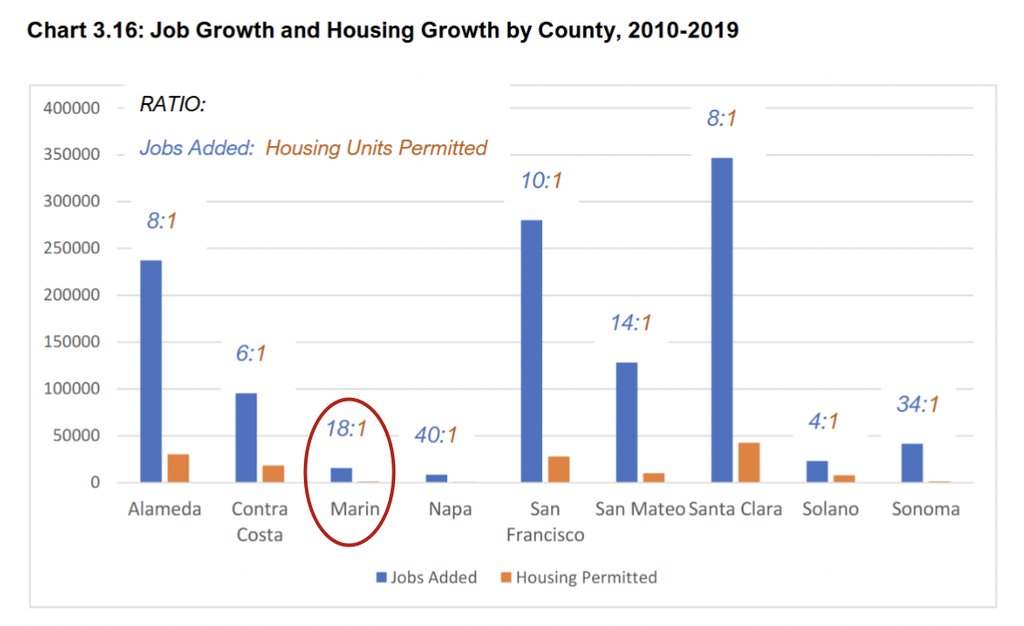
This chart shows jobs added versus housing units permitted (not even built, just permitted) from the last decade, 2010-2019. Marin County added 18 jobs for every 1 housing unit permitted.
Why none of them work alone
Each of the three Ps fails in a predictable way when it stands by itself.
Protection without production just slows the bleeding. Rent stabilization and eviction rules keep current tenants in place, which matters enormously. But if no new homes are added, the shortage stays. Every vacancy becomes fiercely contested, young people and new workers have nowhere to go, and pressure on the existing stock keeps growing, leading to housing costs out of reach for low- and middle-income residents.
Production without protection can accelerate displacement. New construction brings investment, and investment raises nearby land values and rents. Without protections in place, the longtime residents a neighborhood was meant to serve can be priced out before the new homes ever open. Growth that pushes out the people already here is not affordability. It is turnover.
Preservation without the other two is like rearranging deck chairs. Converting a building to permanent affordability saves those units. But if tenants elsewhere can be displaced at will, and if the region adds no new supply, the overall shortage keeps worsening around the edges of what we saved. Rehabilitating aging housing stock without protecting residents from displacement and the community from gentrification preserves the structure but sacrifices affordability and the people that help Marin function.
The reverse is also true. Each P makes the others stronger. Protections buy time for new homes to come online. New supply eases the market pressure that makes protections so necessary and preservation so expensive. Preservation locks in affordability that would otherwise vanish while production catches up. Together they keep people housed today, hold onto the homes we have, and build toward a future where Marin has room for everyone.
What This Means for Marin
The question for Marin is not which P to champion. It is whether we are willing to pull all three levers at once.
That means all of us who call Marin home should ask the same three questions every time we’re asked to consider a protection, preservation, or production proposal. Does it keep people housed? Does it protect the affordable homes we already have? Does it help us build more? A strong housing agenda answers yes to all three.
None of these Ps are sufficient alone. Together, they are how Marin becomes a community where our kids can raise their own families, our workers can live near their jobs, and our seniors can grow old among their neighbors. Call Marin Home invites you to join us in making that case at our fundraiser, Breaking Ground, at Mill Valley Community Center on October 29, 2026.