
The Water is Already Here: El Niño, Flooding, and Housing in Marin
Written by Jessie Rountree, Greenbelt Alliance, and Carly Finkle, Canal Alliance.
Greenbelt Alliance and Canal Alliance are Call Marin Home coalition members.
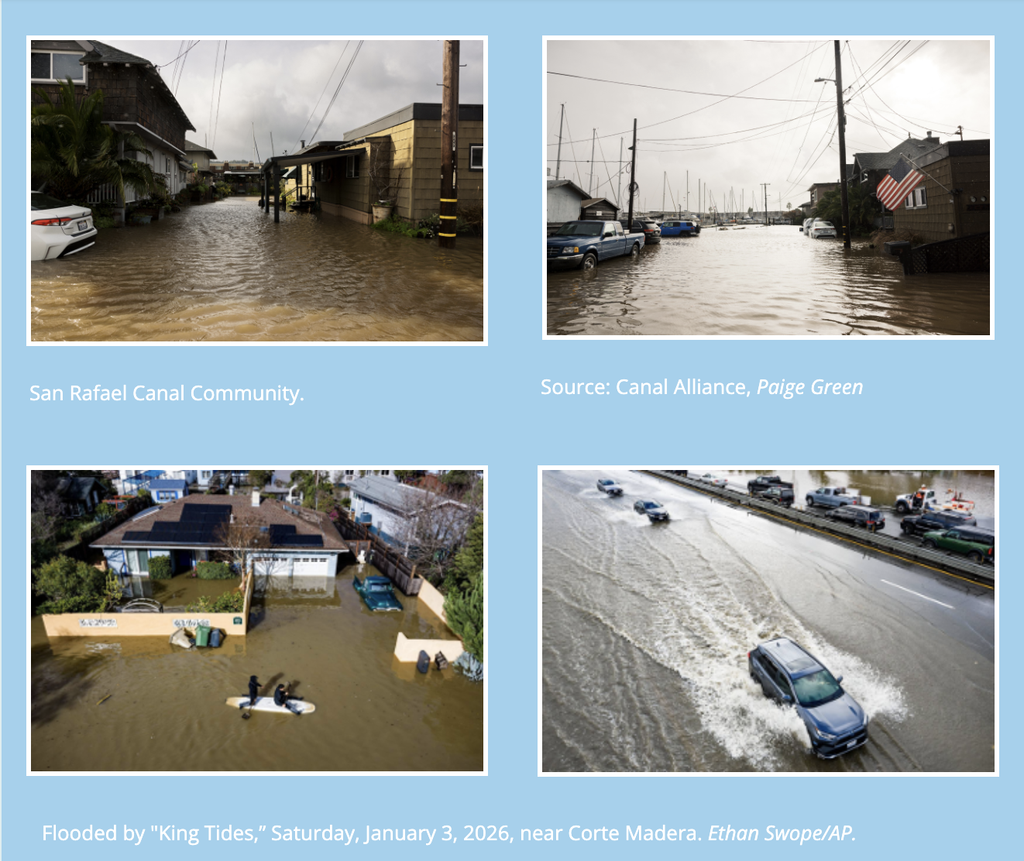
If you live, work, or drive in Marin County, you already know what flooding looks like. High tides and heavy rains bring water that cuts off the roads that emergency vehicles and commuters rely on. It soaks ground-floor homes and garages, overwhelms sewer and stormwater systems, and strands people who can’t easily leave.
In January 2026, water damaged properties in Sausalito, Mill Valley, Corte Madera, and San Rafael. Flooding threatened critical infrastructure and even knocked out 911 service when an AT&T communications hub flooded in San Rafael. Highway 101 near Lucky Drive became entirely submerged and remained paralyzed for hours, with traffic reduced to a single lane in both directions. The transportation disruptions rippled throughout the Bay Area, affecting residents and holiday travel.
This winter is starting far worse, as Marin experienced extensive flooding on sunny, October days. Communities are preparing for a very strong “Super” El Niño weather pattern, with increased water levels, King Tides, and heavy rainfall already creating widespread flood impacts in low-lying areas. Local Marin jurisdictions, as well as California, have declared a state of emergency ahead of the season.
Many low-lying areas of Marin consistently flood during King Tide and storms, and are expected to be inundated again this season.
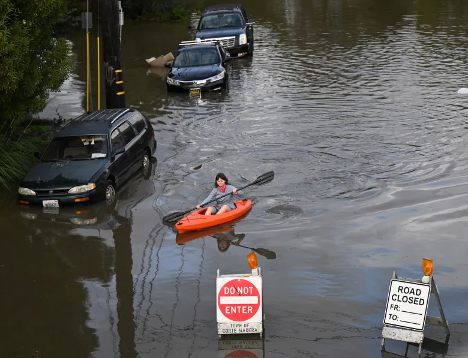
Emily Drake of Corte Madera paddles her kayak to assist stranded people in a flooded area of Nellen Avenue near Lucky Drive in Corte Madera, Calif. on Friday, Jan. 2, 2026. (Sherry LaVars/Marin Independent Journal) Source: https://www.marinij.com/2026/01/10/marins-king-tide-preparations-worked-until-they-didnt/
Flooding exacerbates our housing crisis and community displacement risk
Flooding also threatens neighbors’ ability to stay in the community they love. Marin County does not presently have an adequate supply of safe and affordable homes. That means when a flood makes a home unlivable, families cannot easily move somewhere nearby, forcing community members to move out of the county or live in unsafe conditions.
This is felt significantly in the Canal Community in San Rafael, where sinking baylands, a bowl-like structure that channels rainfall, and dense housing converge. The Canal is one of the most vibrant neighborhoods in Marin, and it’s a neighborhood all of Marin depends on. Our schools, restaurants, health clinics, and stores all rely on the Canal Community. But the neighbors who make the Canal what it is can be pushed out by a single bad storm. And because Marin has such a severe housing shortage, there are few options for those displaced. We need to start planning relocation support and interim housing now, and in parallel.
None of this is inevitable. The Canal is vulnerable in part because of past building decisions and exclusionary home buying practices, but we can make different decisions now.
Three actions would have a huge impact on our community:
Protect the homes that already exist by investing in adaptation solutions so that a flood doesn’t permanently erase housing options.
Provide relocation assistance so that tenants displaced by flooding have a real path back, not just a lost home and a long and likely fruitless search. Unlike homeowners, renters often have extremely limited control over their housing vulnerability and stability during and after a disaster. Without strong tenant protections, a major flood event could lead to permanent displacement, as rental units may be severely damaged or destroyed, and landlords may choose not to repair or rebuild them in a timely or equitable manner
Build more climate-S.M.A.R.T. housing that is Sustainable, Mixed-use, Affordable, Resilient, and Transit-oriented. A larger home inventory offers neighbors more housing options for when flooding and other extreme weather events occur. New homes should be built to withstand flooding and be located wisely, so we aren’t adding more people in harm’s way.
Here are steps to take towards these needed actions and to help ensure that Marin is more resilient to flooding:
This week:
- Sign up for Alert Marin, the primary notification system used by agencies across the County to send critical information and potentially life-saving instructions during emergencies like flooding, wildfires, or evacuations, when action is needed at a specific address or location.
- Know your riskusing this interactive hazard map.
- Get sandbagsand learn how to fill and install them ahead of the Nov 24-26 King Tides.
- Clean gutters and drains of debris.
- Check your insurance and document everything through photographs or video. Standard homeowner’s and renter’s insurance policies usually don’t cover the kinds of flooding we can expect from El Niño or sea level rise, but they may cover other types of storm damage. Flood insurance can be purchased separately by both homeowners and renters, but new policies typically have a waiting period of about 30 to 60 days.
This winter:
- Mark your calendars. King Tides are arriving alongside the Thanksgiving and Christmas holidays. Plan your travel and mind alerts with this in mind. Consider installing the WET (Weather, Event, Tide) app on your phone which provides very good detailed information on King Tides and flooding.
- Anti-tenant displacement actions.People shouldn’t lose their homes because of a flood or because a property owner raised rents after repairs. San Rafael should follow the lead of Novato to create local ordinances to strengthen protections, reduce displacement and support safer, more stable housing for renters.
- Move your car from high flood risk. San Rafael is offering free parking at downtown structures during King Tides on A Street/3rd Street and C Street/3rd Street during predicted high risk periods November 24-29 and December 22-27.
- Make an evacuation plan. Decide where you can go, how you can get there, what you’d bring, and how you could communicate and reunite with your family.
- Be ready to shelter-in-place, including essential medicines and food in case roads are restricted.
- Check in on a neighbor, especially anyone who lives alone or is elderly.
- Be flood smart. Don’t walk, drive your car, or ride your bike through flood waters.
This year: long-term solutions we need
El Niño events are a glimpse of our climate future. According to the Ocean Protection Council, sea levels are estimated to increase by two feet by mid-century, and could exceed seven feet by 2100 under high-emissions scenarios. These actions are essential to create a more resilient future.
- Adaption solutions. Comprehensive sea level rise adaptation is expected to take decades and cost billions, so we need to move now to decide on solutions, secure funding, and begin implementation. San Rafael’s Sea Level Rise Feasibility Study evaluates needed long-term solutions including a tide gate, sea walls, and levee improvements.
- More housing with anti-displacement protections. For example, the shoreline along San Rafael Creek doesn’t have the space needed to build flood protection infrastructure without removing or rebuilding the existing housing, yet this densely populated area is in a potential danger zone. To prevent mass displacement, we must stabilize the community now and take a coordinated, phased approach to building sufficient climate-resilient housing, and create a fair and just plan for relocating tenants. A larger home inventory offers neighbors more housing options for when flooding and other extreme weather events occur. New homes should be built to withstand flooding and be located wisely, so we aren’t putting more people in harm’s way.
We get to decide what comes next
Let’s be honest: this winter is going to be scary. The water that flooded Marin in January is headed our way again. But water is not the only thing shaping our future.
We are.
Every time we protect a home that already exists; stand up for renters; or build safe, affordable housing in the right places, we choose a Marin where families stay rooted in the community they love. Every time we look away, we choose the opposite.
We can’t stop the tides or sea level rise, but we can build a Marin where damages are minimized and the community stays connected.
That future is ours to shape, and it starts with us.
| RESOURCES — The Water is Already Here |
| VIDEO: Housing is a Marin Solution Marin County’s Envision process Seeks community member input for the Countywide Strategic Plan (virtual and in person through mid December). The strategic plan will direct how the County allocates its resources to various programs, including housing. VIDEOS by the City of San Rafael: Rising flood risks in San Rafael, Canal community resilience collaboration project ALERT MARIN: Flooding, Tides & El Niño READY MARIN: Weather Together |

THANK YOU FOR VOTING, MARIN!
The results went our way…
Prop 1 won! Marin’s support was the 3rd highest in the state with 69% voting YES. Only San Francisco and Alameda had a higher percentage. And Prop 43 went down with 66% of Marin voting NO, among the strongest opposition in the state. Now we must make the legislation work for us.
We are a broad and strong coalition
Call Marin Home is a collaborative partnership of leading Marin County organizations working to create systemic change that expands access to affordable, workforce, and accessible housing in order to ensure that everyone in Marin has a place to call home. The coalition continues to grow. Interested in joining? Email Jenny. View our current membership here >>.
| Our donors and sponsors make our work possible. Donate now |
| Your advocacy and support have helped us do more, reach a broader audience, and get results. Every contribution, big or small, makes a meaningful difference and helps us continue and expand our mission. You can donate here.Thank you for your support. |